

One system. Create, control, run.
The Agent Factory creates — every kind of specialist agent, for every sector, with the governance requirements declared for that customer built in. The control plane controls: the AI of your choice works freely inside the agent, and every action that has an impact on the real world passes the gate. The Driver Seat runs: a human in the loop, the operator at the wheel. One declared contract runs through all three, and one system serves all your customers.
HexaBox builds new AI agents and governs agents connected from other systems.
An agent is software that carries out defined tasks. Each connected agent operates under a mandate: what it may do automatically, what requires human approval and what is forbidden. HexaBox checks proposed actions before they reach connected systems and records each decision. People set the boundaries, follow the work and intervene through a shared view.
Think of it as a cognitive exoskeleton for your customers' teams: the agent processes information and carries out authorized actions at machine speed; people make the decisions that require human authority.
HexaBox sits on top of what you already run. Nothing is replaced.
People act. Agents work. Everything is controlled. Your systems stay the same.
Ask. Approve. Watch.
Investigate this alert.Operatorasks
Looks right. Approve.Supervisorapproves where the rules say so
Fleet running as expected.IT managerwatches the fleet
Show me the impact.Business ownersees the outcome
Two places to act — the Driver Seat and the Conversation Cockpit. Four ways to see what happens — fleet, agent, customer, environment. Never a black box.
Agents work freely. Every action is controlled.
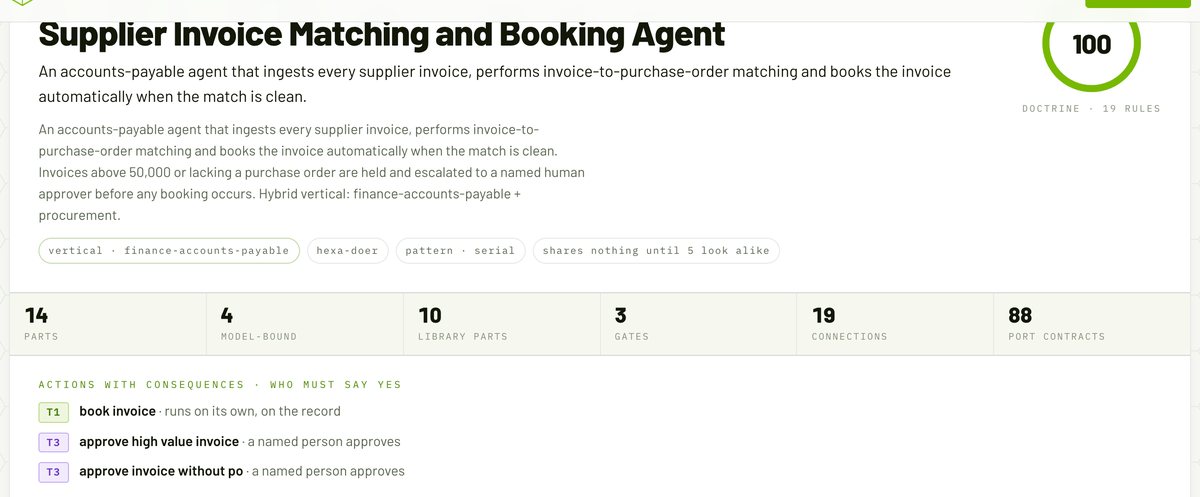
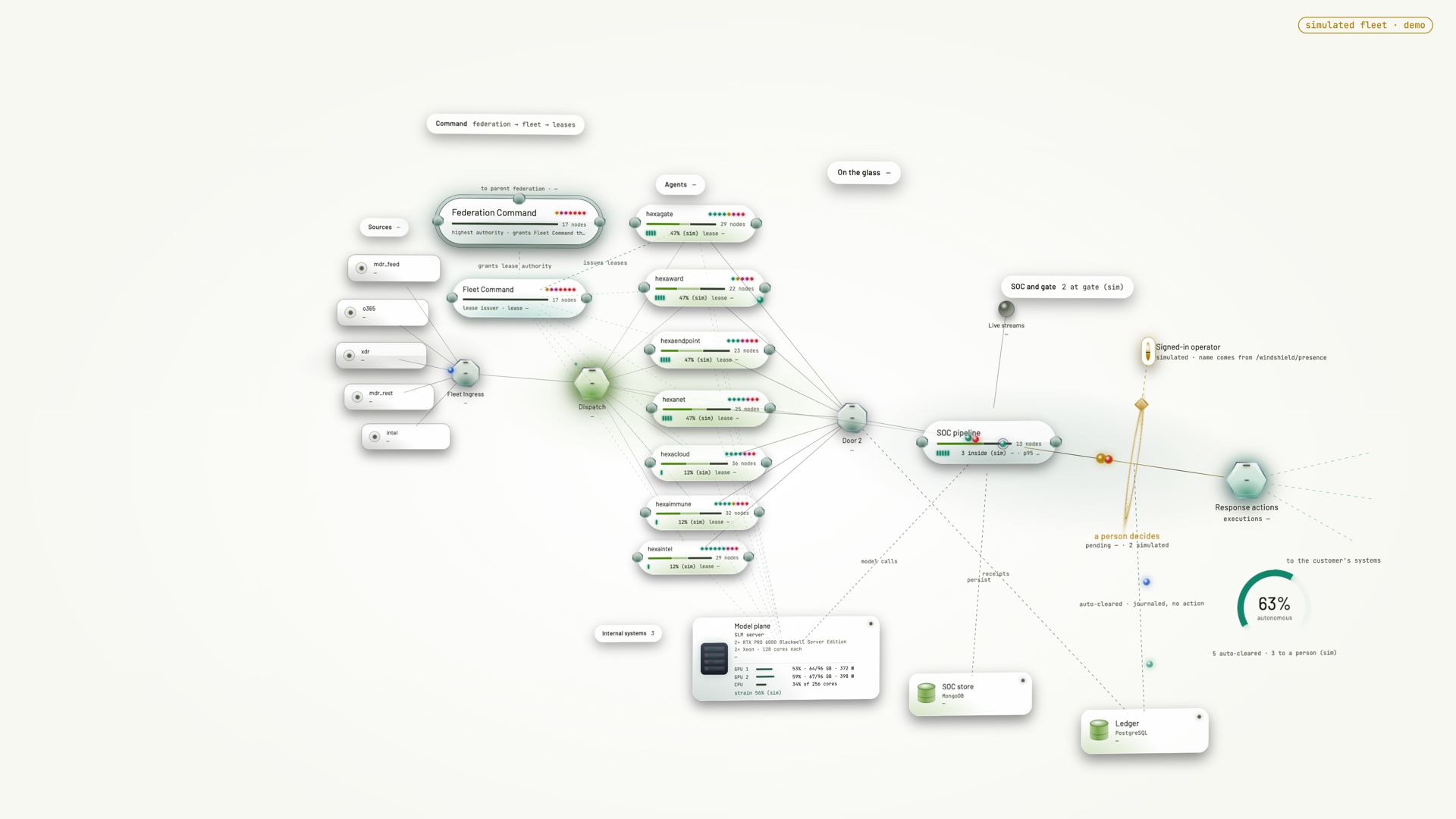 Fleet view · the Wind Shield
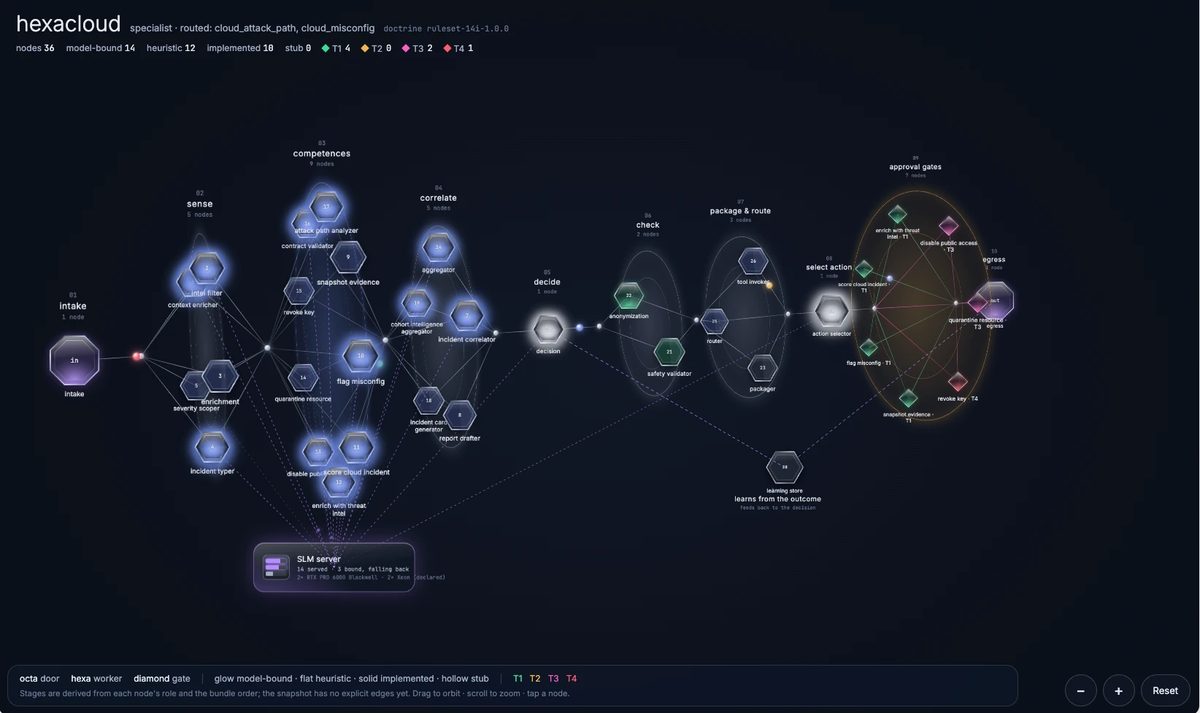 Agent topology
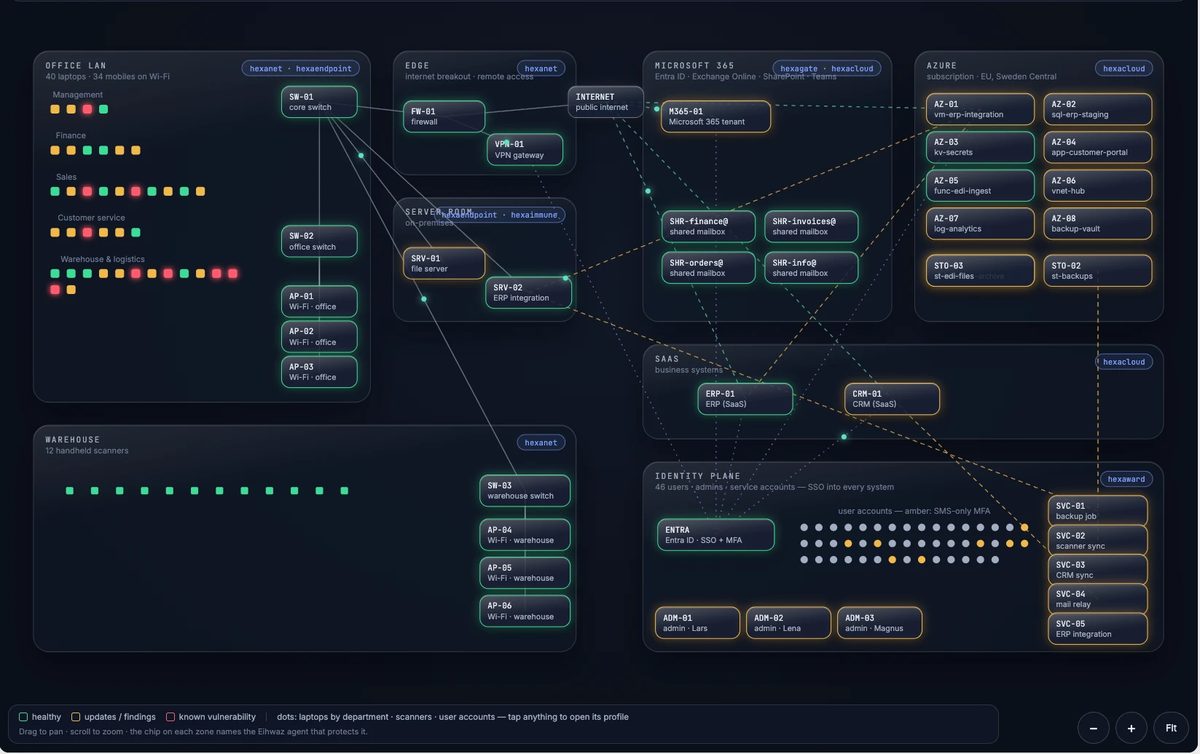 Customer tech world
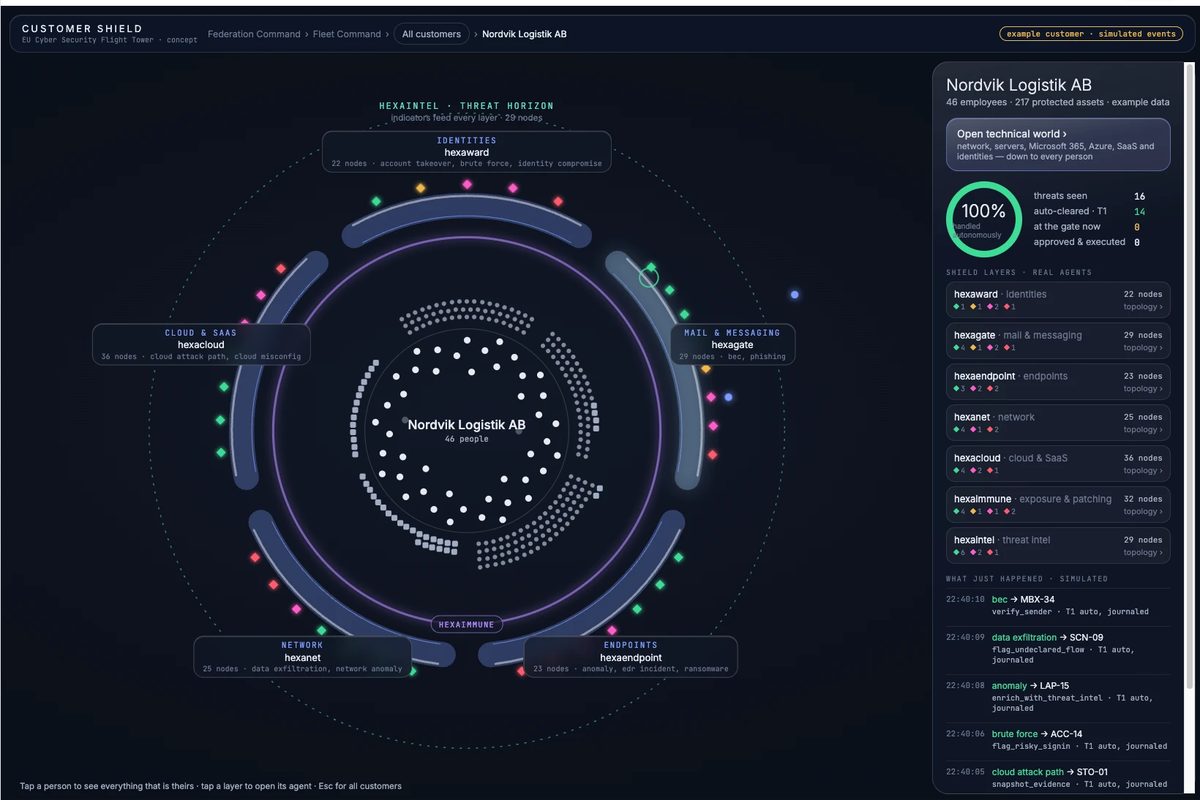 Customer Shield
Sealed: change one byte of an agent and it stops. The agent uses a replaceable model through a defined interface — any provider, any model, your own.
Your systems, your cloud, your AI — every one a replaceable part.
The agent uses a replaceable model through a defined interface, and the systems around it are replaceable too. Swap in a better model when it arrives, use a lean one for the routine, replace a business system — the agents' rules, their record and what the fleet has learned stay. That is why the system does not grow old while the models change every few months, and why the pace of AI development works for you instead of against you.
In the cloud, on your servers, or on the customer's own.
Whichever you choose, you host and operate the environment, as you do today. HexaBox is the engine; the customer relationship stays with you.
Connected through the APIs you already have — read and write. Any system, any model, wherever it runs.
AI is getting better every month. Your system gets better with it.
New models arrive faster than anyone can plan for. With HexaBox that is not a reason to wait — it is the reason you can start now. The system separates the choice of AI model from the rules that govern its actions: the model is a part you introduce, evaluate and replace as better ones become useful, while the declared mandates, approval requirements and record stay in place. What you build today keeps its value when next year's models arrive.
Start now. Every improvement in AI from here on is yours to use.
A job description in. A governed agent out.
You describe the job the way you would describe it to a new colleague: what to read, what to decide, what to do, and where a person must say yes. The factory does the rest, the same way every time.
The first HexaBox agent
The Agent Factory is itself a HexaBox agent — the first one ever built, under the same gate, the same levels and the same record as everything it makes. It was then used to build Eihwaz, our AI-driven cyber-security fleet. If any rule fails on the factory itself, it cannot ship anything.
Sectors are skins on the same engine
Never the starting point. The agent runs in your cloud, as a package, or on your customer's own servers. Connectors are chosen when the job is described; a connector built once is reused for every customer after that.
Rules that run as code, not as a document.
Before any action touches a real system, the gate checks identity, mandate, level, evidence and approvals. The same way, every time, on every path — in the factory, in the fleet, in Eihwaz — our cyber-security fleet — and on the analyst's screen.
| Level | Who must say yes | Typical actions | Human in the path |
|---|---|---|---|
| T1 | Pre-authorized — actions explicitly permitted to run automatically within the declared mandate; each execution is recorded | looking things up · acknowledging a report · a routine step the mandate explicitly allows, such as quarantining a matching message | none |
| T2 | One person confirms, one click | low-risk, reversible steps · the proposal is shown, the person confirms | one |
| T3 | A named, logged-in person approves | isolate a host · block indicators · disable an account · pay above a limit | one, by name |
| T4 | Two independent people, two keys | fleet-wide mode changes · the largest transfers · anything irreversible at scale | two, never the same |
The action decides its level — nobody can pick a lower one when asking.
Change one letter and it no longer counts.
The approval is tied to the exact content of the exact action.
Who, their role, and when it expires — inside the approval.
Nothing can be swapped afterwards.
The agent can check an approval. It can never create one.
The signing key never lives where the agent runs.
An approval works exactly once.
It cannot be reused or replayed.
Expiry is judged on a trusted clock, and the agent needs a valid permit.
No permit, no action.
Tied to one version of the rules.
An approval given under an older version of the rules does not carry over.
Master stop
One button suspends further agent actions across the fleet — and it is recorded.
Default: locked down
An action needs a valid permit and whatever approvals its level requires. A failed check blocks it — locked down is the resting state, not an exception path.
Three illustrated scenarios. Five checks each.
An agent proposes an action. Before it touches a real system the gate checks identity, mandate, level, evidence and approval — the same five, every time, on every path. The action runs, waits for a person, or never runs. Every outcome lands on the record.
We control the action. Not the intelligence.
Use the AI models and platforms that fit your needs — Anthropic, OpenAI, fine-tuned small language models or your own. HexaBox checks consequential actions against the declared mandate before they execute. Agents work autonomously within that mandate, with human approval where required. Your operators oversee the fleet from the Driver Seat, with the visibility and authority to intervene. The agent proposes an action; HexaBox checks whether it is authorized to execute.
The gate, in motion: three illustrated scenarios, five checks each →
Four tests, run in the partner evaluation.
No single part here is new — locked-down-by-default and checking before acting are known ideas. What we claim is a property of the whole, and it is only visible when you look at the whole. Four tests show it. They are run together with HexaBox in the partner evaluation, on a fleet you can inspect.
Partners get the full engineering — the gate, the levels, the keys, the record — and the test suite behind these four. The record and the agent identity can be re-verified independently at any time.
One person at the wheel of the whole fleet.
A control screen for the human, generated for every agent — never hand-built. What it shows comes from the same record the auditor reads.
How autonomous is the fleet. What did it do alone. What needs me.
The autonomy gauge and the trust level, live decisions streaming, and one amber card asking for a human.
Autonomy per customer, inside the mandate.
Agents act autonomously within their mandate. Actions requiring additional authority wait for the required approval. The mandate is set per customer, can be narrowed at any time — and it is recorded.
The decision is recorded before anything runs.
A proposed action is shown with its reason and its level. The highest level needs two people.
One click, and the human drives.
A master stop suspends further agent actions across the fleet. Late work stays red; a struggling agent says so; the full record is one click away.
Ask the fleet anything. It answers from the record.
A grounded assistant inside the seat. Every answer is built from what the agents did and recorded, and can be checked against the record. It explains an incident, a decision, a rule; it says when it does not know; it never acts.
The same control, by conversation.
Brief me. Show me what waits at the gate. Approve this one. The same state as the seat, in plain words — and every action still passes the gate at its level.
See every agent at work.
The view out through the windscreen: sources, specialists, the gate, the actions — every event travelling the chain, from all fleets down to one decision. The four zoom levels →
The same screen, limited to one customer.
Calmer: am I protected, what happened, what do you need from me, what did you send. A seat, not a portal.
One agent, a fleet, a fleet of fleets — the same rules at every level.
Every agent carries the same contract structure. The fleet that governs the agents carries the same structure. So does the fleet of fleets. The same structure — not the same mandate: each level holds only the authority declared for it.
The rules are inside. What it may do, where it must ask and what may leave — written in when it is built, checked on every change.
Fleet Command sees every agent at once — who runs, under which mandate — and can change or revoke a mandate for the whole fleet in one place. It runs under the same contract as every agent in it.
Federation Command governs many fleets — departments, subsidiaries, partners. It issues each fleet its time-limited permit, sees counts and never content, and keeps a signed ledger of cross-fleet effects.
Built in
Agents from the HexaBox Agent Factory carry the contract from the first line.
Placed around
Agents you already run, whoever built them, get the same gate, the same record and the same fleet governance — as they are. Placed around, the contract does not give the Factory's control of what happens inside the agent. We say so plainly.
The receipt. Checkable without us.
Who proposed, what was authorised, who approved, what happened. One tamper-evident chain per customer, covering every hand-off between agents, every gate decision, every approval and closure. Reports carry the chain hash and the instructions to verify it — a third party checks it offline, without HexaBox in the loop.
Reports are written from recorded facts.
Unsupported sentences are dropped, and the drop is counted.
Drafted · reviewed · approved · delivered · acknowledged.
Every report has one of five states, and the customer sees it in their own seat.
Every agent carries a signed, root-chained identity.
Its build score, any drift from it and its permit are signed and can be re-checked on demand.
Defined requirements built in, enforced at the action, evidenced on the record.
Governance mechanisms enforced and re-checkable on every agent, and the sector standards whose requirements you translate into policy per customer, with the evidence structured for review. HexaBox ships the evidence; certification is an audit, and we give the auditor what to audit — structural conformance, not certification.
See an agent's structure built, in about a minute.
Describe an agent and watch the real factory build it — the top of its Studio view and its topology in 3D.