
Eihwaz: every alert read, every action gated — and all of it on the record.
Eihwaz is our AI-driven cyber-security fleet: a security operations centre (SOC) built on HexaBox — the first fleet the HexaBox Agent Factory built — nine agents in operation through a managed security provider. It reads every alert, investigates it, proposes the response and writes the report — at machine speed, around the clock. Every consequential action passes a tiered authority gate before it can run; your analysts sit in the Driver Seat. Many IT-service and security companies buy their security operations in from somewhere. Eihwaz is a SOC you can own: finished, in production, ready to implement under your brand — a new business you control instead of one you resell.
Autonomous AI intelligence. Every consequential action checked before it runs.
Email, identity, endpoints, network, cloud, vulnerabilities, threat intelligence — every alert read, every dot connected, the same rigour at alert 4,000 as at alert 4. The specialists' intelligence runs on the fleet's own trained models and works freely; every action that touches a customer's systems is controlled. The specialists assess, sign and propose — they never execute. Your analyst sits in the Driver Seat: consequential actions wait for a human, the most severe for two.
One customer, one calm view.
The Customer Shield: one customer's people in the centre, the seven shield layers around them, the three answers on the right. A simulated customer — tap a person, a layer or an answer.
- A case comes inAn alert from one of the customer's sources lands with the specialist for that layer. On the Shield it is a dot on the ring, in the colour of its severity.
- An action needs a yesThe specialist proposes a response. Anything that touches the customer's systems waits at the gate; the person answers the three questions on the right.
- The decision is on the recordWhat was proposed, who decided and what ran is written to the customer's chain. The counters on the Shield count exactly that.
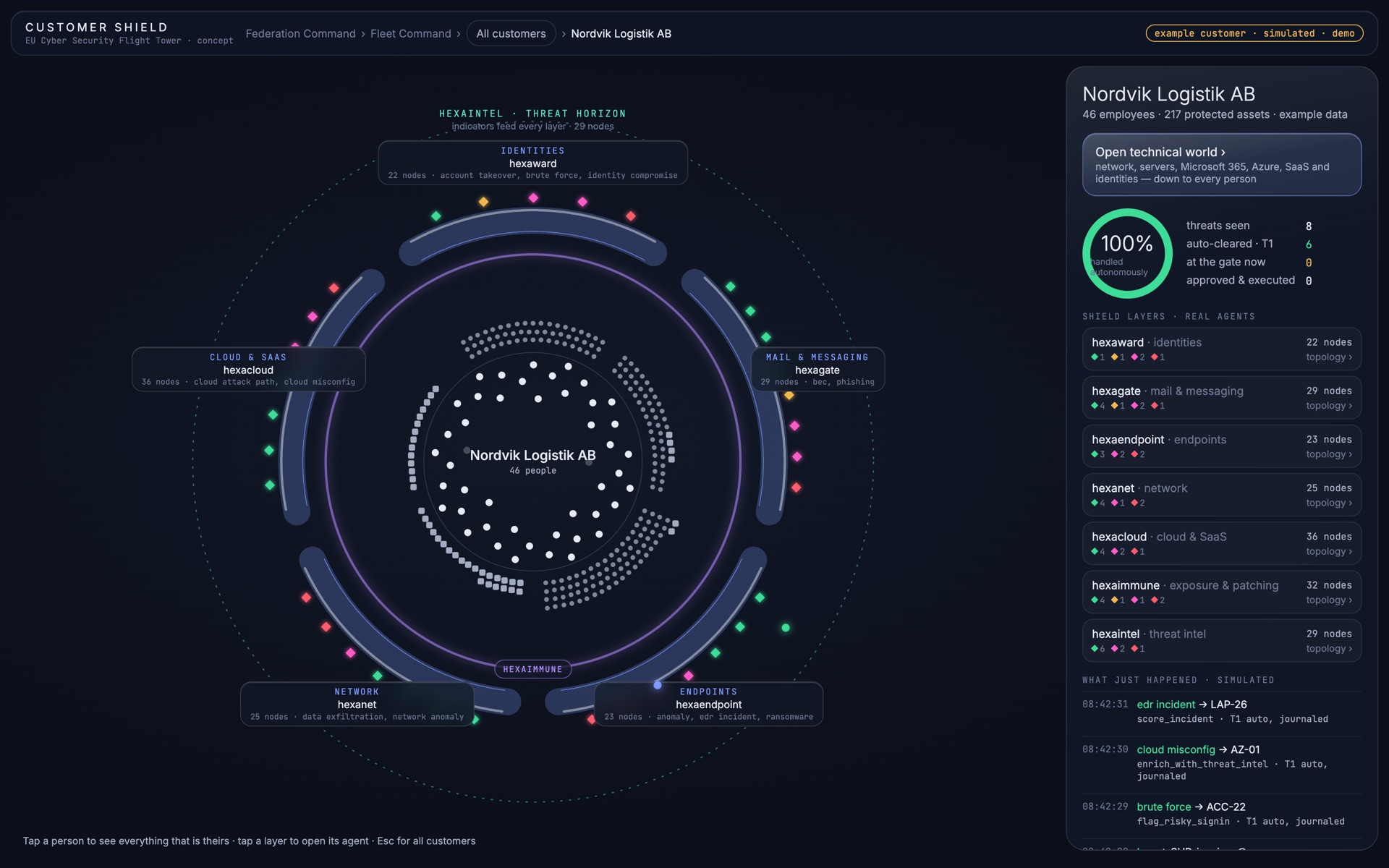
A simulated customer, on this public site by design. The real seat draws the real customer, behind the login.
Open full screen ↗Seven specialists assess, sign and propose. They never execute.
One hub decides, with a human in the Driver Seat. One coordinator shares learning across customers without moving customer data. Seven specialists, one per domain. All of them built by the HexaBox Agent Factory — itself the first HexaBox agent, governed by the same gate, levels and record as the fleet it built.
Phishing, business email compromise, malicious links and attachments.
Identity
Accounts, sign-ins, privilege changes, takeover attempts.
Endpoints
Processes, malware behaviour, ransomware, lateral movement.
Network
Traffic, intrusion signals, exfiltration paths.
Cloud
Misconfiguration, SaaS and cloud control-plane events.
Vulnerabilities
Exposure, patch state, exploited weaknesses.
Threat intelligence
Indicators that feed every other layer.
One incident, one plan, one response
The SOC correlates the specialists' signed assessments into one incident and one plan. Fleet Command takes events in and may act only within its lease.
What happens between an alert and an action a person has approved.
An illustrated incident. It follows Eihwaz's real action types and mechanisms step by step, in the order they run; it is not a replayed production event, and it carries no customer data, timestamps or figures. Where a step names a rule or a check, that rule exists in the running system.
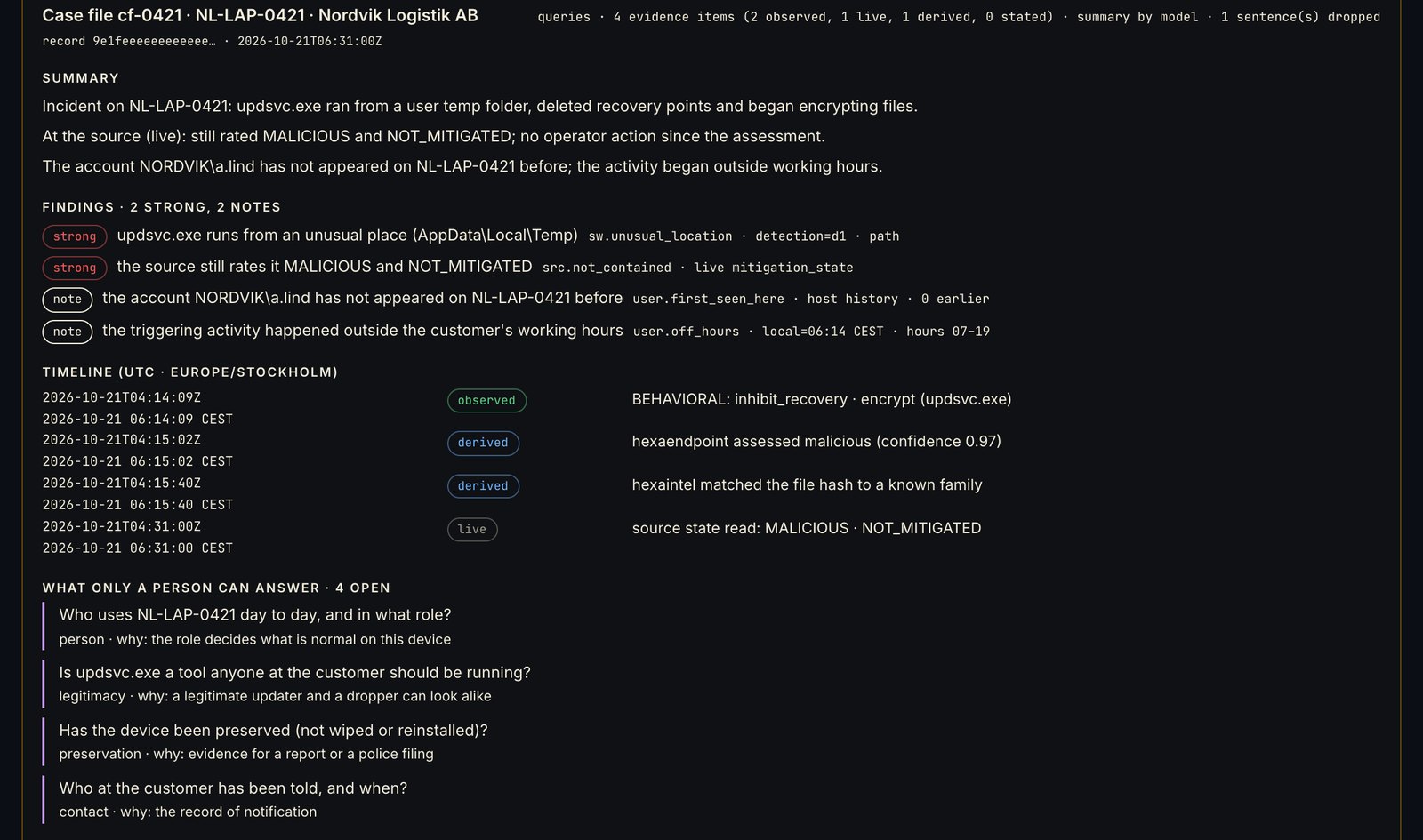

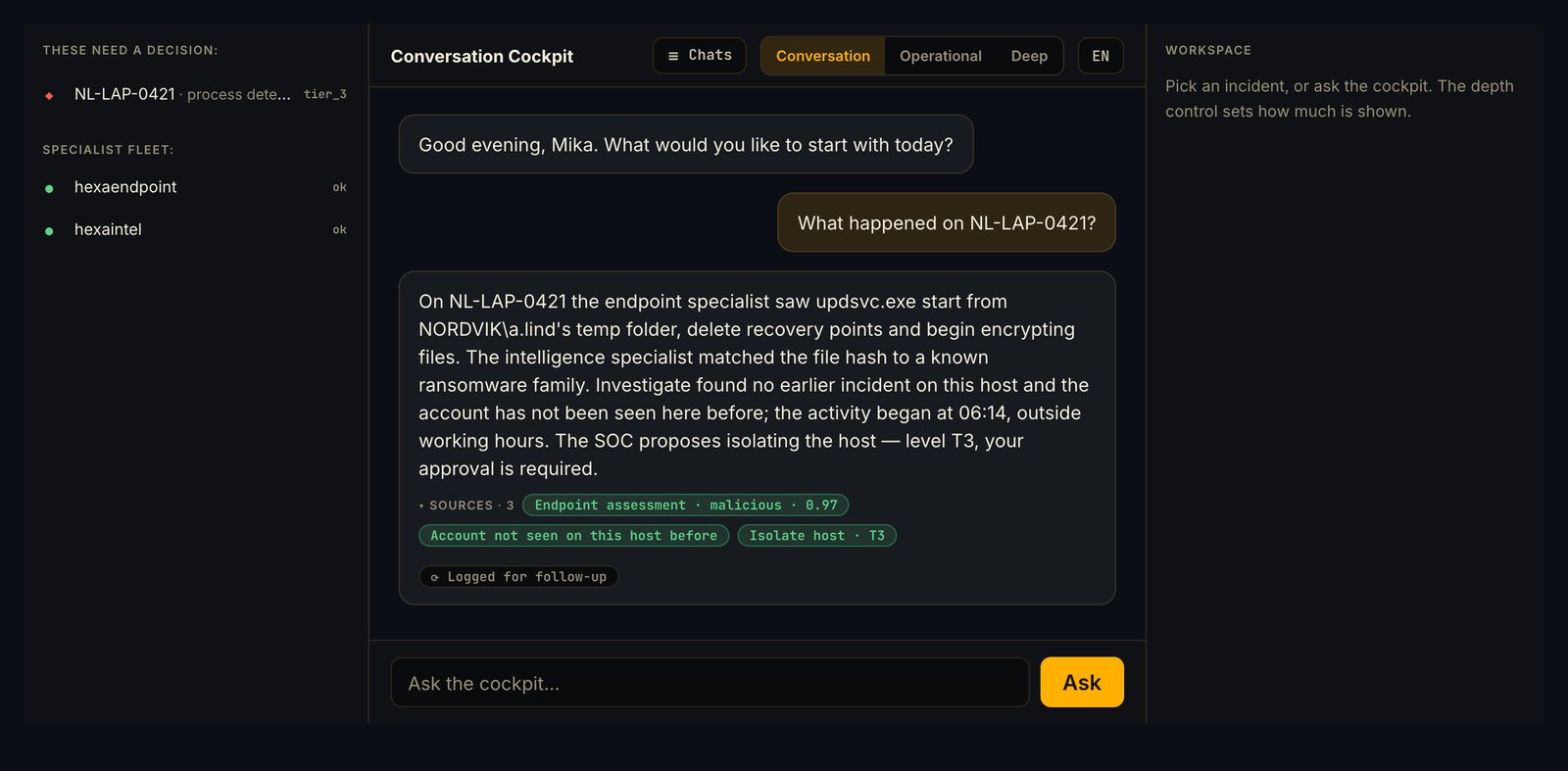
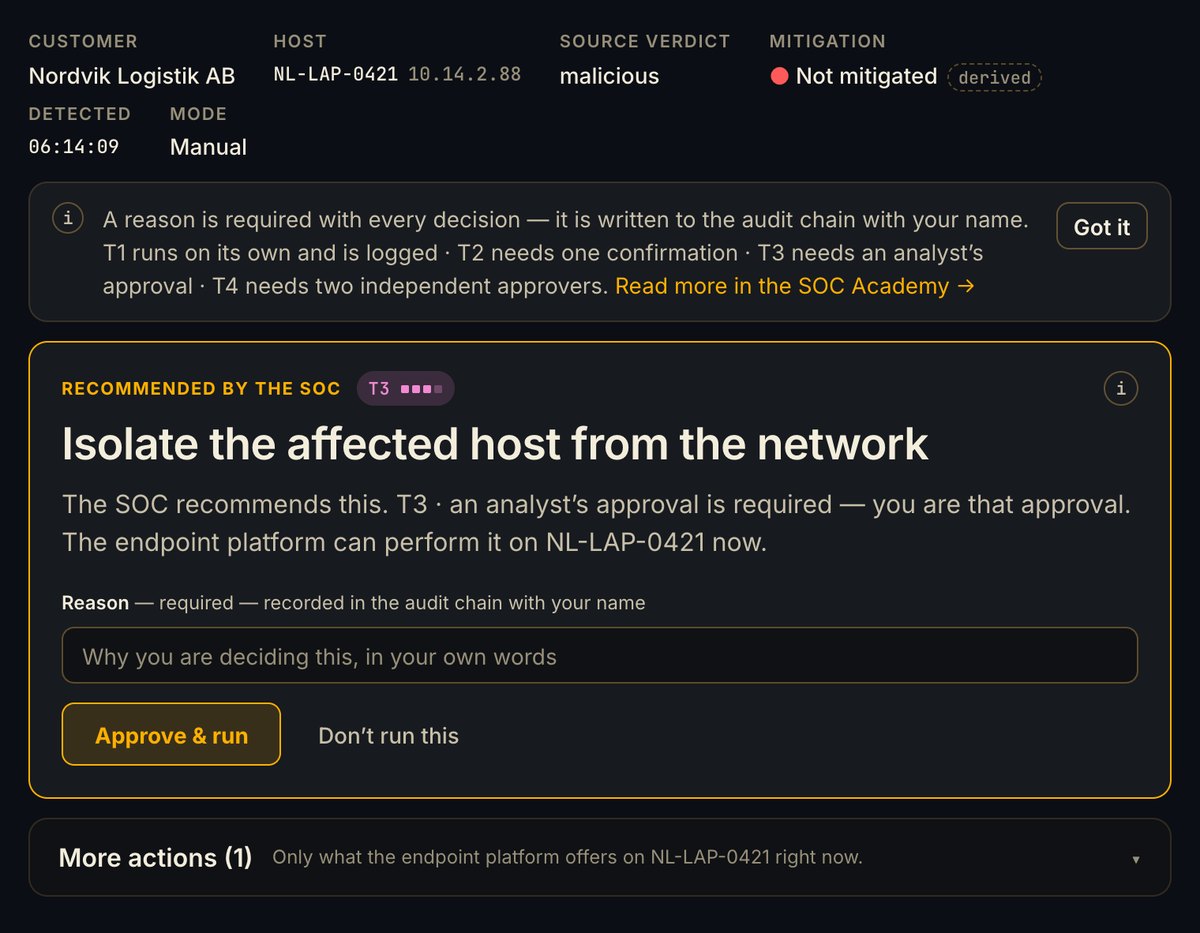
What this shows is the mechanism, in the order it runs. A documented incident from production will replace it when one can be published in anonymised form.
From the customer's world to the customer's own seat.
Federation Command above
Governs a fleet of fleets: issues each Fleet Command its time-limited permit, sees counts only — never names, never a customer's content — and keeps a signed ledger of cross-fleet effects.
Partners in front
A security provider sees the whole tree with its own analysts and branding; each reseller sees its customers and its report inbox; a direct customer hangs straight under the provider. One fleet, every customer kept separate.
Am I protected? What happened? What do you need from me?
Every customer of the provider has their own seat — calmer than the operator's, limited to their own world: the people, the laptops, the cloud services, the sites, and the agent that watches each of them. A simulated customer: drag to pan, scroll to zoom, tap anything to open its profile.
- A case comes inAn event starts somewhere in this world — a mailbox, a laptop, a cloud service. Watch for the pulse on the node where it begins.
- An action needs a yesThe agent watching that part proposes what to do. Tap a node to see its profile and which agent covers it; actions that change the customer's systems wait for a person.
- The decision is on the recordEvery decision about this world ends up in the customer's own chain, and shows in their seat — not only in the operator's.
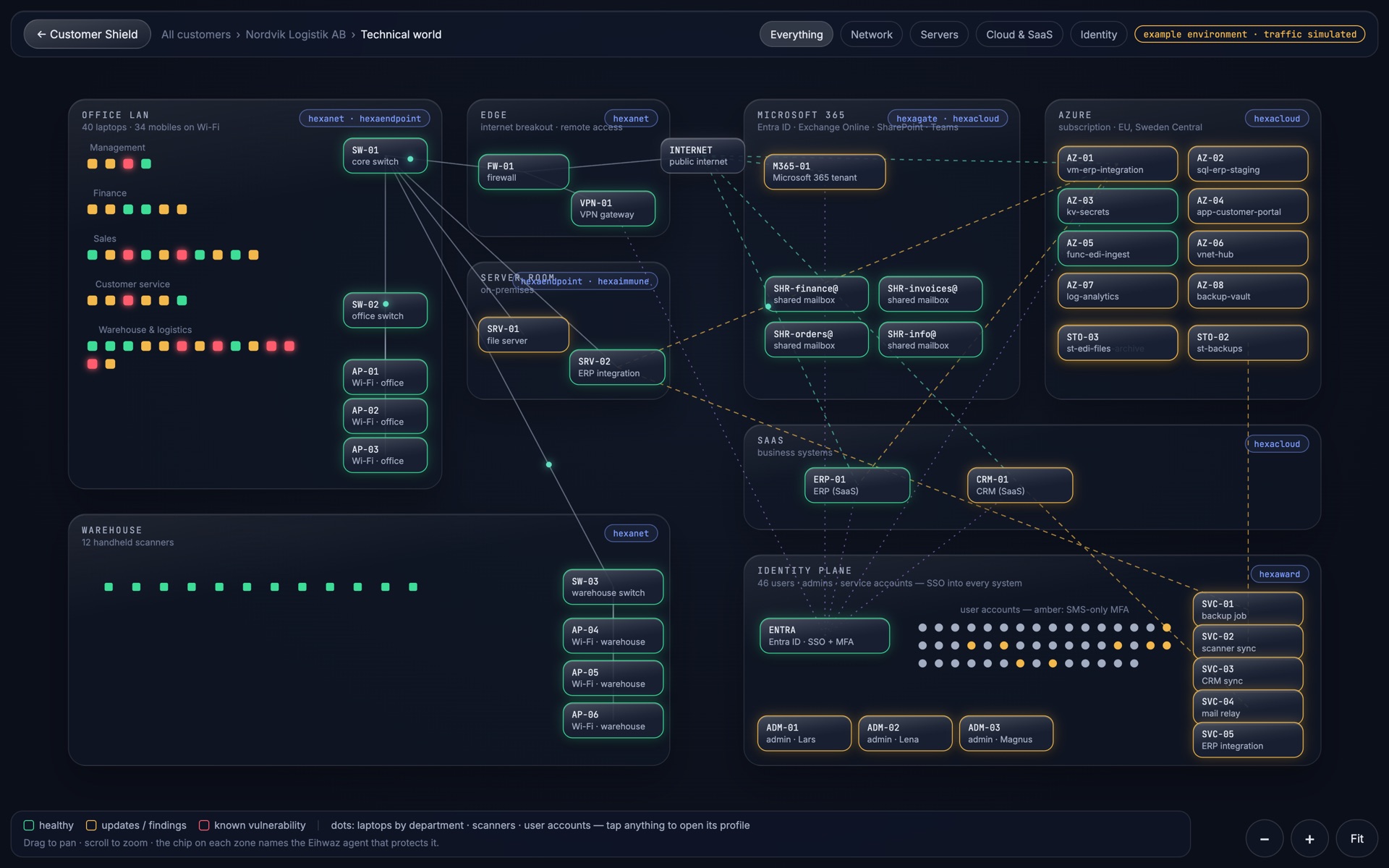
A simulated customer, traffic simulated — on this public site by design. The real seat draws the real world, behind the login.
Open full screen ↗Sovereign, honest, and teachable.
No external dependencies in the decision path.
In Eihwaz the specialists' assessments run on the fleet's own trained models, on the fleet's own hardware, so no customer content leaves for a decision to be made. The advisory assistant that answers questions and writes reports is a separate, configurable model, never in the decision path. This is a choice Eihwaz makes for a security operation; HexaBox itself allows any model, including external providers, and the customer's declared policy decides what may leave and what may not.
Start from one thing. See what it is connected to.
Detection finds what it was told to find; investigation finds the rest, across the whole history. A fixed, read-only plan runs first; the report is written from those facts alone — a sentence naming anything not in the facts is dropped and counted.
Clear. Honest. Take the wheel.
The autonomy gauge, the trust level, live decisions — and one amber card asking for a human. A supervisor learns it in an afternoon; overdue work stays red; manual override is one gesture away. Autonomy is a dial, not a leap of faith.
Trained and examined on the real thing.
Foundation, specialist operations and a threat-hunter practical graded by the fleet against a planted intrusion. Every analyst decision becomes a labelled example the specialists train on next.
Industry background, not an Eihwaz result: in IBM's Cost of a Data Breach 2024, organisations using security AI and automation extensively identified and contained breaches 98 days faster on average than those that did not, and extensive use in prevention workflows was associated with USD 2.2 million lower average breach costs than no use. Eihwaz is built to put that kind of speed under human authority.
Machine speed, human authority.
One fleet, every customer kept separate.
Multi-tenant isolation inside one fleet; signals shared across customers are counts only, never names — and only when at least five customers look alike.
Audit material as a by-product.
The incident evidence a NIS2 review asks for comes out of running the agents, against the requirements your team has defined.
Eihwaz is proof of one vertical — not a boundary for the HexaBox architecture.
See every agent at work. Then take the wheel.
The Wind Shield for the Eihwaz fleet: sources, Fleet Command, the seven specialists, the SOC, the gate and the actions. Simulated here — drag to orbit, tap a container to open its graph; live behind the login.
- A case comes inFollow an event from a source on the left, through Fleet Command and Dispatch, to the specialist that reads it.
- An action needs a yesAfter Door 2 and the SOC pipeline the proposal reaches the gate — the ring marked 'a person decides'. Pre-authorized steps pass; the rest wait.
- The decision is on the recordWhat leaves towards 'Response actions' has been decided, and the Ledger at the bottom holds the receipt. The autonomy gauge counts what ran on its own.
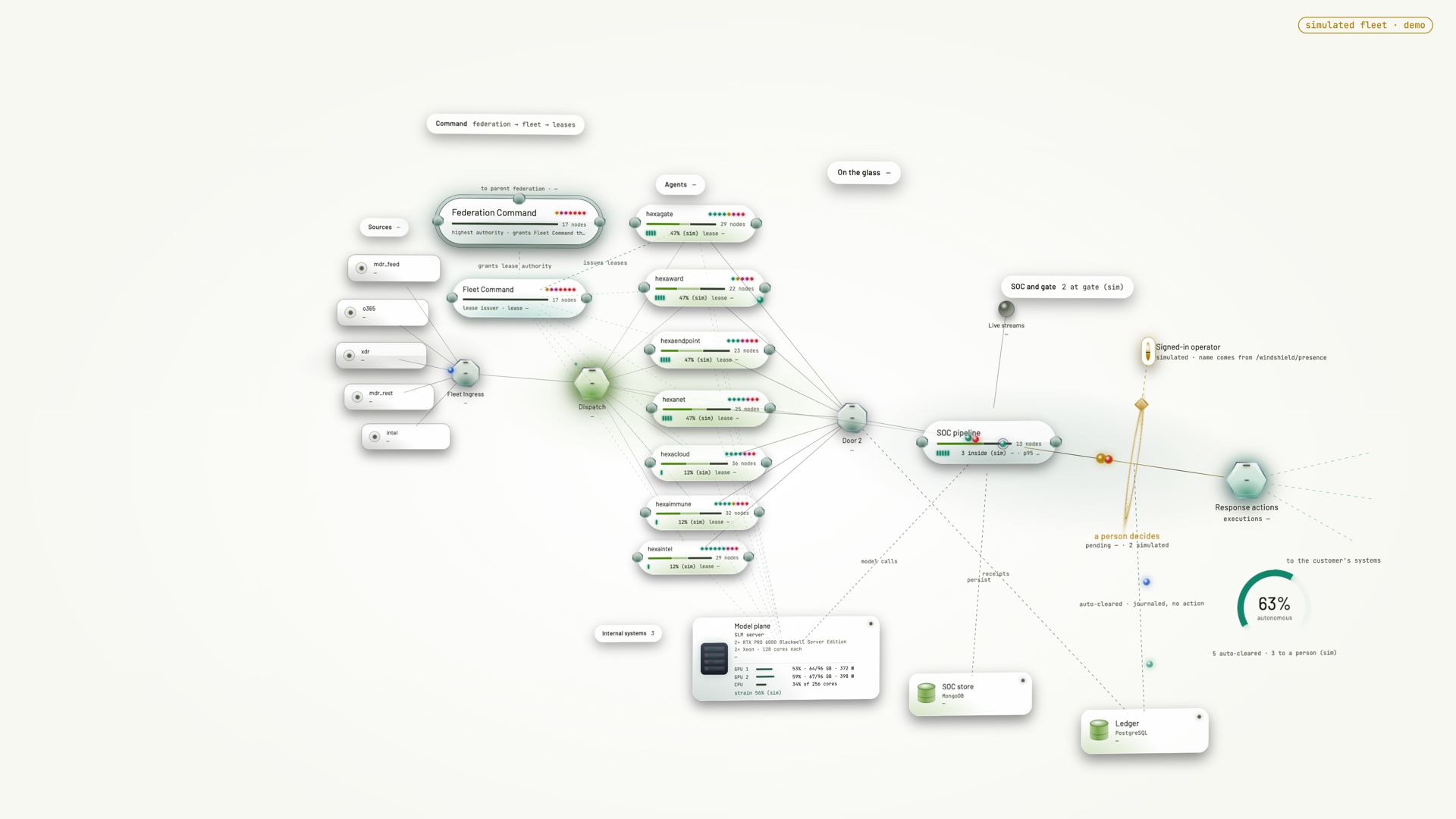
A simulated fleet with simulated events. Behind the login the same view draws the real fleet and shows problems as they are.
Are you ready to go AI-first in your SOC operations?
Eihwaz is finished and in production. Implement it under your brand, with your analysts in the loop and your customers in their own seats — a SOC business you own. Twenty minutes on your screen is the right first step.